Fluid Academic Roadmap
Table of Contents
Fluid Academic Project Plan, April 2007-March 2009
Document Status
This project plan is a living document and is reviewed and updated regularly in order to accurately reflect the community's state of progress.
This page provides an at-a-glance view of the current activities and goals of the Fluid Project. We are currently working on Fluid Infusion 1.0 and beginning work on Fluid Engage.
Defining Releases
Fluid's release plans reflect a layered approach; the core framework team breaks work up into regular iterations, usually two weeks in length, to ensure our progress is visible to the entire community and to better respond to the needs of our user experience stakeholders. Packaged, documented versions of the software are released quarterly.
- 0.x Releases: Released quarterly and announced to the public on the fluid-announce mailing list; packaged, documented, and supported.
- Major Version Release: Only one during the Mellon-funded period; aim for a full Fluid 1.0 release by March 2009
How Planning Works
We try to keep our planning process as light and simple as possible, recognizing that priorities and tasks shift over time, and that we'd prefer to spend our working on great designs. The Fluid team has three levels of plans:
- The project plan: this document. A high-level view of the goals and deliverables of the funded project as a whole
- Release plans: more detail the deliverables we expect to include in each release
- Iteration plans: usually based on a two-week iteration, this lets us track individual tasks and assignments
More information on Fluid's planning process.
Component Prioritization Plan
The approach we've taken to prioritizing which components we work on and when is based on combining known issues in Sakai, uPortal, and OpenCollection with ongoing user research and a strategic direction towards re-envisioning how content is managed in both applications. We will continue to collect suggestions for components from stakeholders and experts in the communities. Early prioritization of these suggestions will be based on educated guesses and identifying clearly problematic yet manageable areas to improve. As progress is made on the UX Walkthroughs, usability studies, and user research, our priorities will be driven by the results of this research. We'll also make some key component choices based on the desire to address critical accessibility customizations and accommodations where necessary, allowing us to explore runtime adaptations of the user interface.
Impact of the Fluid Deliverables
The Fluid technologies will be closely integrated into essential aspects of the Sakai, uPortal, and OpenCollection applications. We will work closely with existing teams and project stakeholders to do this in a highly collaborative, community-led manner. While the details may shift based on the need to responsively target high priority problems, we expect to see Fluid's largest impacts in the following areas:
- File Management:
- Uploading content
- Finding, selecting, and working with content
- Tagging and metadata
- Navigation:
- Organizing page sections and portlets
- Identifying favourites and landmarks within a portal or site
- Customizable tabs that scale gracefully
- Accessibility:
- Customizable keyboard navigation
- ARIA support for assistive technologies
- Flexible presentation: adjustable fonts, layouts, etc.
- jQuery accessibility plugins and mentorship
- Framework:
- Unified, pure HTML templates on the server side
- Component model for enabling customization and configurability
- Conventions and APIs for markup-driven user interfaces
Release Milestones
April-July 2007: Community Building
Goals:
- Get started
- Install, configure and use community infrastructure: mailing lists, wiki, etc.
- Recruit volunteers and nurture a healthy community of UX expertise
- Demonstrate our technology direction by demonstrating a viable "first slice" component
Deliverables:
August-November 2007: Fluid 0.1
Goals:
- Get the Lightbox and Reorderer into the hands of developers
- Establish a release process
Deliverables:
December 2007: (No Release)
Goals:
- Planning user research
- Improvements to Fluid 0.1 deployment bundle
Deliverables:
January-May 2008: Fluid 0.3
Goals:
- Talk with users: build up a firm foundation of understanding of user practices and needs
- Build new components and flesh out framework designs
Deliverables:
June-July 2008: Fluid 0.4
Goals:
- Build the Inline Edit and Pager components
- Launch and collaborate on the Open Source Design Patterns Library
- Introduce a preview version of client-side template rendering
Deliverables:
- Fluid 0.4 Framework Deliverables
- Fluid 0.4 UX Team Plan
August-September: Fluid 0.5
Roadmap
October-December-January 2008: Fluid 0.6/0.7
Goals:
- Build a user preferences editing component
- Integrate runtime accessibility adaptations based on user preferences
- Release extensive new design patterns
Deliverables:
- Fluid 0.6 Framework Deliverables
- Fluid 0.6 UX Team Plan
Roadmap
- Infusion 0.6 Roadmap
February 2009: Fluid 0.8
Goals:
- New components
- Community outreach and training
Deliverables:
- Fluid 0.8 Framework Deliverables
- Fluid 0.8 UX Team Plan
Roadmap
- Infusion 0.8 Roadmap
March 2009: Infusion 1.0
Goals:
Deliverables:
- Fluid 1.0 Framework Deliverables
- Fluid 1.0 UX Team Plan
Roadmap
- Infusion 1.0 Roadmap
- Infusion 1.0 Wish List
May 2009: Infusion 1.1
Roadmap
---------------------------------------------------------
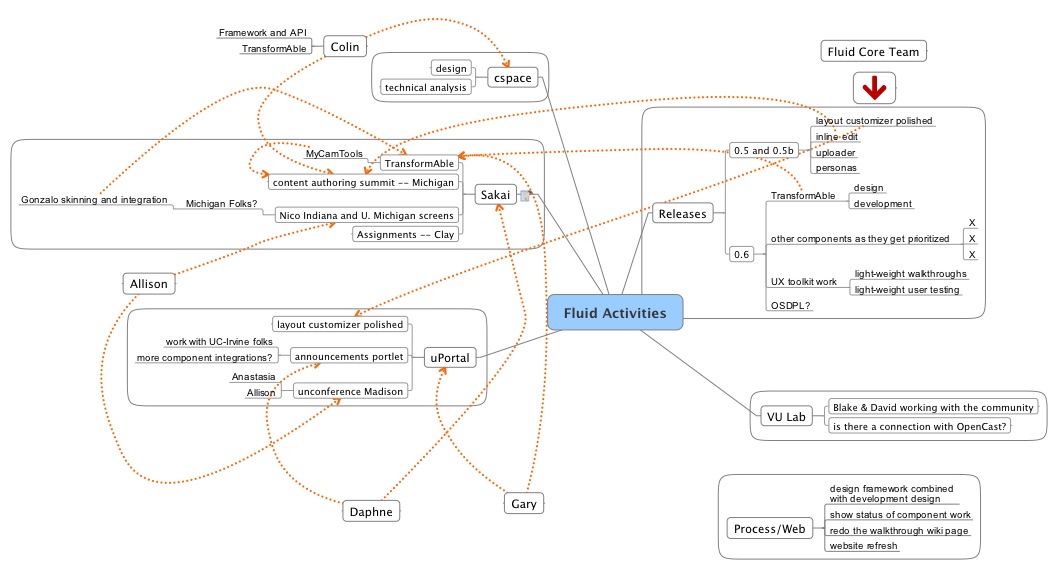
This is a map that was presented at the Fluid Monthly Teleconference September 3, 2008 to demonstrate upcoming work, community participation, and how our work tied in with the larger project goals. It is a snapshot of those details from that moment in the project.